
Understanding Your Energy Bill: Where Does the Money Go?
Ever wonder why your electricity bill is so high when you only "used" a few hundred dollars' worth of power? The truth is, you aren't just paying for the energy that lights your lamps; you’re paying for a massive, multi-stage industrial journey that spans hundreds of miles.
Every line item on your bill has a 1-to-1 relationship with the physical journey electricity takes to reach your front door. Let’s follow the money through the grid.
1. The Generation Plant (The Cost of Raw Power)
The journey begins at a massive plant where fossil fuels—typically natural gas or coal—are burned to create energy.
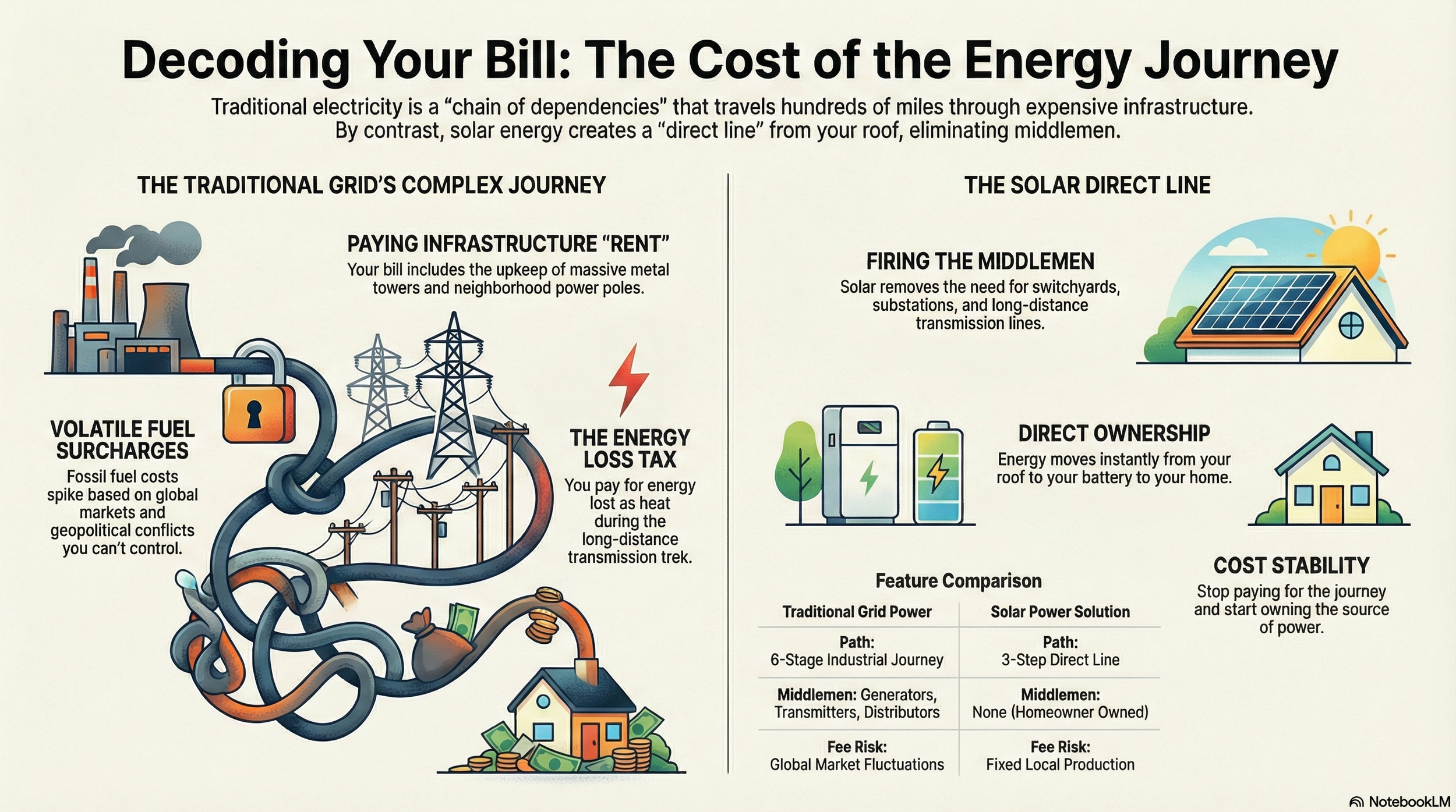
The Hidden Cost: You aren't just paying for the energy; you’re paying for the fuel. Because these resources are often tied to global markets and geopolitical conflicts, your "Fuel Surcharge" can spike at any time based on world events you can't control.
2. The Switchyard & Transmission (The Long Haul)
Once produced, the energy goes to a Switchyard to be sent onto the main electrical grid. From there, it travels via high-voltage Transmission lines across counties.
The Hidden Cost: Look for "Transmission Charges." You are paying for the upkeep of those giant metal towers and the energy lost as heat during the long-distance trek.
3. Substations & Distribution (The Final Mile)
Before it reaches your neighborhood, the power hits a Substation to be stepped down to a safer voltage, then moves through Distribution lines (the poles on your street) to a local transformer.
The Hidden Cost: "Distribution Charges" often make up a huge chunk of your bill. You are essentially paying rent for the wires that deliver the product to your house.
4. Consumption (The End of the Line)
Finally, the power reaches your home for Consumption. Your meter tracks this final step, but as you can see, it's only the tip of the iceberg.
The Solar Solution: Cutting Out the Middleman
When you look at the complex, expensive stages required to produce traditional power, the decision to go solar becomes simple.
Traditional Power is a chain of dependencies: Generation → Switchyard → Transmission → Substation → Distribution → Consumption
Solar Power is a direct line: Your Roof → Your Battery → Your Home
By producing your own power from the Florida sun and storing it right where you use it, you effectively "fire" the grid for most of these stages. You stop paying for the long-distance travel, the substation maintenance, and the volatile fuel costs of global power plants.
Stop paying for the journey. Start owning the source.
